Problem overview
The Doppler Effect, named after the Austrian physicist Christian Doppler, is a phenomenon in physics that describes the change in frequency or wavelength of a wave in relation to an observer moving relative to the source of the wave. In simpler terms, it explains why the sound or light from a moving object appears different to an observer compared to when the object is stationary.
live demo
I've also made little web demonstration (all gifs are from this demo), you can play with it here.
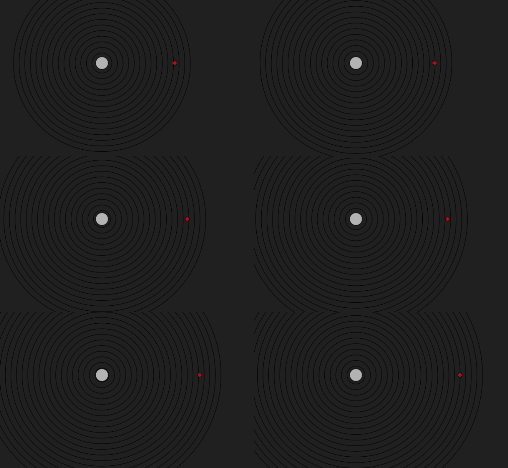
observer is moving away of source

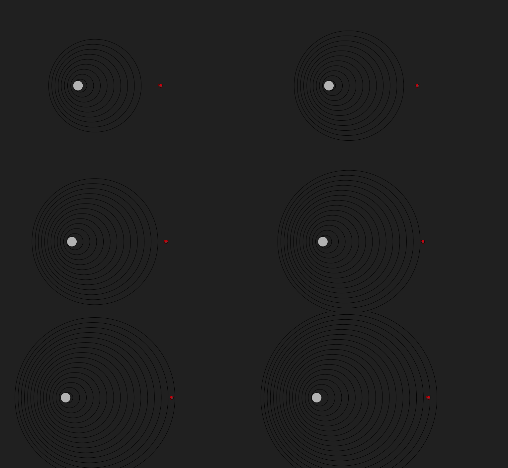
both objects aren't moving

source is moving toward observer
red = observer, gray = source
problem introduction
Looking at the gifs you can clearly see that observer "touches" waves with diffrent frequency. From these gifs it's also clearly seen that frequency depends on velocity of source and observer. It's important to note that we'll discuss only movement on the same axis (that means you can create displacement vector which always has the same direction).
Let's talk about what happens when observer is moving:
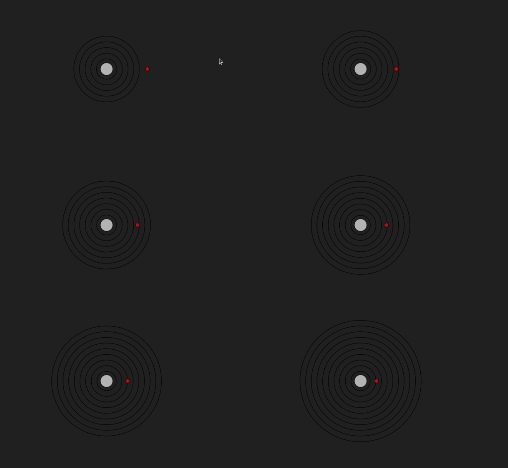
observer is moving toward source
observer is moving away of source
As we can see if observer is moving toward source,
frequency is less than original one. When is moving away
frequency
is greater than original one. When observer is
moving toward source, it is "crashing" with waves,
but when is moving away, it is running away of them.
The equations for an observer moving toward or away from a
stationary source can be combined into one equation:
$$f_{o} = {V \pm V_{o} \over V}$$
where fo is observed frequency, fs is source'
frequency, v is velocity of the wave and vo is velocity of
observer.
If observer is moving toward source, we're adding velocity, because
frequency then is larger than original.
If observer is moving away of source, we're subtracting velocity, because
frequency then is less than original.
Let's talk about what happens when source is moving:
source is moving toward observer

source is moving away of observer
As we can see if source is moving toward observer,
frequency is greater than original one. When is moving away
frequency is less than original one. When source is
moving toward observer, waves of it are closer to each other,
but when is moving away, they are away of each other.
The equations for an source moving toward or away from a
stationary source can be combined into one equation:
$$f_{o} = {V \over V \pm V_{s}}$$
where fo is observed frequency, fs is source'
frequency, v is velocity of the wave and vs is velocity of
source.
If source is moving toward observer, we're subtracting velocity, because
frequency then is larger than original.
If source is moving away of observer, w're adding velocity, because
frequency then is less than original.
combined formula
When observer and source are moving at the same moment, we can combine 2 formulas into 1.
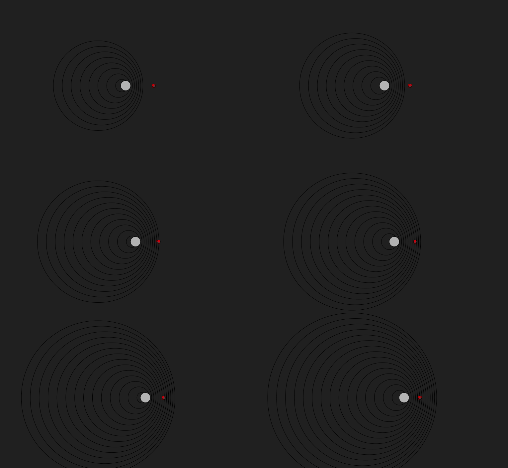
both objects are moving in the same direction